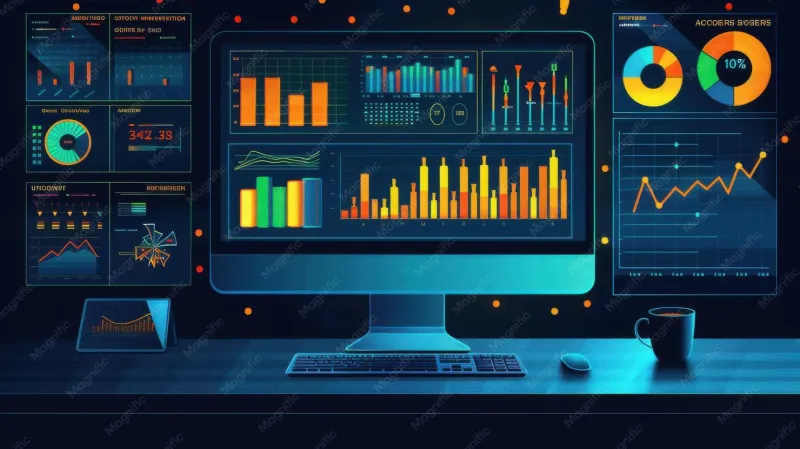
Logged, Tagged, and Sorted: The People Who Turn Their Obsessions Into Personal Databases
Photo: Kskhh, CC BY-SA 4.0, via Wikimedia Commons
Somewhere in a Google Sheet right now, a person in Ohio is logging the exact roast level, origin country, and latte art quality of every independent coffee shop they've visited since 2019. They have 340 entries. They have a color-coded rating system. They have a tab dedicated entirely to oat milk availability.
And honestly? We respect the hustle.
This is the world of the personal database builder — a quietly thriving subculture of obsessives who've decided that simply enjoying a thing isn't enough. The thing must be documented. Categorized. Cross-referenced. Preserved in a format that could, theoretically, be queried.
It Started With Letterboxd (But It Didn't Stop There)
If you've spent any time in film circles online, you already know Letterboxd — the social platform that lets users log every movie they've ever watched, rate it, review it, and add it to themed lists. It's a beautiful, chaotic archive of personal taste, and it basically normalized the idea that tracking your media consumption is a legitimate hobby in itself.
But Letterboxd was just the gateway drug.
For a certain type of person, that platform scratched an itch they didn't know they had — and then sent them spiraling into building their own systems for things Letterboxd couldn't cover. Video games, obviously. Books, sure. But also: every bar they've visited in their city. Every hot sauce they've tried. Every version of a specific sneaker colorway they've spotted in the wild.
Reddit communities like r/datacollection and r/Notion have become informal gathering spots for these people, where they share screenshots of their setups the way other folks share vacation photos. The response is always the same: a flood of "what template is this" and "okay I need to do this for [extremely specific thing]."
The Craft Is the Point
Here's what's easy to miss from the outside: for most of these folks, the database is the creative project. It's not just a tool for remembering stuff — it's an expression of how their brain works, what they value, and how deeply they're willing to go on something they love.
Take Marcus, a 28-year-old from Austin who has spent the last three years building a personal archive of every professionally released wrestling entrance theme since 1985. We're talking song title, promotion, wrestler name, year introduced, whether it was original composition or licensed, and a personal "banger rating" out of ten. He's got over 2,000 entries.
"People think it's weird," he says, "but it's the same energy as someone who alphabetizes their vinyl. You're creating order around something you care about. It just happens to live in Airtable."
That framing — database as curation, as craft — keeps coming up. There's a reason platforms like Notion, Obsidian, and Airtable have developed almost cult-like followings. They give regular people the tools to build something that feels genuinely theirs, even if it's technically just rows and columns.
The Hyperspecific Is the Whole Vibe
What makes this corner of the internet so distinctly NicheCraft is the specificity. Nobody's out here building a database of "all movies." That's what IMDb is for. The personal database people are doing things like:
- A spreadsheet tracking every fictional food item mentioned in a specific author's entire novel catalog
- A running log of every time a particular shade of burnt orange appeared in a TV show's costume design
- A database of every local news broadcast intro jingle from the 1990s, sorted by state
- An archive of discontinued regional fast food items, with columns for approximate last-seen year and "grief level"
The grief level column is real. Someone actually built that.
This is what separates the personal database from a simple list or a Pinterest board. The columns are where the personality lives. Anyone can write down "I tried this pizza." Only you would add a column called "structural integrity under fold" and another called "vibes of the guy who handed it to me."
Community as a Side Effect
Here's the thing nobody really predicts when they start one of these projects: other people find it, and then something unexpected happens.
Jamila, a 34-year-old librarian in Atlanta, started a personal Notion database cataloging Black-owned bookstores across the Southeast — hours, specialties, whether they had a reading nook, event frequency. She built it for herself, shared a screenshot in a Facebook group, and within two weeks had strangers emailing her asking if they could contribute entries.
"I never meant for it to be a community thing," she says. "I just liked having the information organized. But apparently other people wanted that too, and suddenly I'm maintaining something that matters to more than just me."
This is a pattern. The personal archive goes public, people want in, and suddenly the spreadsheet becomes a shared infrastructure. It's a different kind of community-building than a Discord server or a subreddit — quieter, more structured, but just as real.
The Analog Roots of a Digital Habit
None of this is actually new, which is worth saying. Collectors have always been catalogers. Baseball card collectors kept binders with meticulous condition ratings. Record store employees maintained handwritten inventory systems that were basically personal databases with aesthetic. Trainspotters in the UK have been logging locomotive numbers in notebooks since the 1940s.
What's changed is the friction. Building a spreadsheet in 2024 takes ten minutes. Sharing it with the world takes thirty seconds. And the tools — Notion, Airtable, even just Google Sheets — have made it possible to build something genuinely sophisticated without knowing a line of code.
The barrier between "I have a weird interest" and "I have a weird interest and a searchable archive of everything related to it" has basically collapsed.
So Why Does It Feel So Good?
Psychologists who study collecting behavior point to a few things: the satisfaction of completeness, the pleasure of imposing order on chaos, the identity-building that happens when you declare "this is the thing I know everything about."
But there's something else going on with the database builders specifically. Unlike physical collecting, there's no shelf space limit. No cost per item. The archive can grow indefinitely, get more detailed, branch into sub-tabs and linked databases. The obsession has room to breathe.
And in a media environment that's constantly pushing you toward the algorithm's version of your interests, there's something quietly radical about maintaining your own record. Your own taxonomy. Your own rating system, with your own weird columns.
The spreadsheet doesn't know what's trending. It only knows what you cared enough to log.
That's the whole point.